
 The World's Healthiest Foods are health-promoting foods that can change your life.
Try our exciting new WHFoods Meal Plan.
The World's Healthiest Foods are health-promoting foods that can change your life.
Try our exciting new WHFoods Meal Plan.
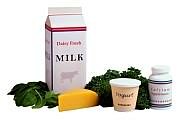
Grass feeding is a practice not yet familiar to all consumers. 100% grass-fed cow's milk comes from cows who have grazed in pasture year-round rather than being fed a processed diet for much of their life. Grass feeding improves the quality of cow's milk, and makes the milk richer in omega-3 fats, vitamin E, beta-carotene, and CLA (a beneficial fatty acid named conjugated linoleic acid). (For more detailed information about grass feeding, please click here.) Just how important is grass feeding for cow's milk quality? As you will see in the chart below, we have included grass feeding as one of our top-level recommendations for anyone who plans to include cow's milk in their meal plan:
| Shopping for Cow's Milk | |
| Stick with organic | Organic standards help lower risk of contaminated feed and organic cow's milk usually has higher nutrient quality. However, remember that organic by itself does not guarantee a natural lifestyle for the dairy cows. |
| Ask for 100% grass-fed | Go beyond organic by asking for 100% grass-fed. Don't get sidetracked by the confusing array of labeling terms like natural" or "pasture-raised." Labeling laws allow products to display these terms even if dairy cows spend little or no time outdoors in a pasture setting. Unfortunately, even the term "grass-fed" is not sufficient since grass-fed dairy cows may have spent a relatively small amount of time grass feeding. The standard to look for on the label is "100% grass-fed." Talk to your grocer or the dairy cow farmer and find out how the animals were actually raised. In addition, if you would like more information about the practice of grass feeding, please click here. |
| Consider local farms | Organic, 100% grass-fed cow's milk may be available from local farms with small flocks, which provide a natural lifestyle for their dairy cows. Two websites that can help you find small local farms in your area are www.localharvest.org and www.eatwild.com. Both sites are searchable by zip code. |
One thing you'll notice about the chart above is an absence of recommendations about percent fat. Provided that you keep your serving size for grass-fed cow's milk at 4 ounces or less, we recommend that you consume it in the form of whole milk. Not only is whole milk the least processed form of milk (placing it in the category of a whole, natural food), it's also the form of grass-fed milk that will provide you with the most omega-3s and other key nutrients. Traditionally, health organizations have not recommended whole milk in the diet but rather reduced fat milk, including 2%, skim, and nonfat milk. Since too much total fat, too much saturated fat, and too many calories in a daily meal plan can raise the risk of certain health problems, this traditional approach makes sense for individuals who cannot make room in their daily meal plan for the amount of total fat, saturated fat, and calories contained in whole milk. However, we believe that many people who may want to include a 4-ounce serving of grass-fed milk in their meal plan will be able to include it in the form of whole milk while still remaining within the guidelines for intake of total fat, saturated fat, and calories.
When obtained from 100% grass-fed cows, whole milk contains a surprising diversity of both conventional and phytonutrients. In the conventional category, you'll find milk to be a very good source of vitamin B2 (riboflavin), vitamin D, and vitamin B12. It's also a very good source of the minerals iodine and phosphorus, and a good source of calcium. Our rating system also qualifies whole cow's milk as a good source of protein.
As described previously, the fat composition of 100% grass-fed whole cow's milk is not what you might think. In an 8-ounce serving, you're likely to get at least 50-65 milligrams of omega-3s (in the form of alpha-linolenic acid, or ALA) and perhaps as much as 120-150 milligrams. You're also going to get a relative low ratio of omega-6:omega-3 fat in the range of 2:1 to 3:1. That ratio is healthier than the 8:1 (or higher) ratio you're likely to get from conventionally fed cows, and it's also much healthier than the ratio currently consumed by the average U.S. adult. Included within the fat composition of 100% grass-fed whole milk is CLA (conjugated linoleic acid), a type of fat associated with immune, cardiovascular and other benefits.
In terms of phytonutrients, you're likely to get 16-40 micrograms of beta-carotene in 8 ounces of 100% grass-fed whole cow's milk, along with isoflavones like formononetin, biochanin A, and prunetin depending on the type of fresh pasture and silage consumed by the cows. You're also like to get lignans like secoisolariciresinol and matairesinol, once again, depending on the cows' diet. The chart below gives some simple examples of the relationship between a cow's diet and phytonutrients in milk.
| Type of Silage | Phytonutrients Found to Increase in the Cow's Milk | |
|---|---|---|
| red clover | formononetin (isoflavone) | |
| alfalfa | biochanin A (isoflavone) and prunetin (isoflavone) | |
| birdsfoot trefoil | secoisolariciresinol (lignan) and matairesinol (lignan) |
Grass silage has also been shown to increase the beta-carotene content in grass-fed cow's milk to levels of approximately 40 micrograms in 8 ounces. These levels are about 4 times higher than the amount of beta-carotene found in conventional cow's milk.
Antioxidants found in 100% grass-fed whole milk can include the isoflavones formononetin, biochanin A, and prunetin. Antioxidant lignans can include secoisolariciresinol and matairesinol. Vitamin antioxidants include vitamin E (which is increased by about 50% in milk from 100% grass-fed cows versus conventionally fed cows) and mineral antioxidants include selenium and zinc. Grass feeding also increases the amount of another key antioxidant—beta-carotene—in cow's milk. At approximately 40 micrograms per 8 ounces, this level is about 4 times higher than the level in milk from conventionally fed cows.
There are preliminary studies on the health benefits of cow's milk in a variety of areas. However, we're not aware of any large-scale studies done exclusively on 100% grass-fed whole milk. Most of the studies have been conducted using milk from conventionally fed cows on relatively small groups of participants. Within this context, there is some evidence of improved weight loss and improved fat loss when cow's milk is incorporated into a closely monitored low-calorie diet.
There is also evidence of decreased risk of gout in both men and women when milk is consumed in relatively high amounts (averaging at least one cup per day, and often 2-4 cups). Researchers are not clear about the mechanism of action here, but continue to look at relationships between increased intake of cow's milk and decreased levels of uric acid in the blood. (High levels of uric acid usually precede the occurrence of gout.)
While cow's milk has been widely promoted as a source of calcium and good bone health, we have not seen large-scale studies showing significantly improved bone health in adults who regularly consume cow's milk. We have seen several studies involving decreased risk of bone fracture in children and teens who regularly consume milk, and we've also seen animal studies showing reduced risk of osteoporosis following regular milk consumption. Some of the research on bone health and the natural nutrient composition of cow's milk is complicated by widespread fortification of cow's milk with vitamin D. (Vitamin D plays an important role in bone health, and the addition of vitamin D to cow's milk during processing might account for improved bone health.)
Studies on the relationship between cow's milk intake and cancer risk are confusing, and to a certain extent, contradictory. Some studies have shown mild decreases in cancer risk (for example, breast cancer in one group of French women), while other studies have shown mild increases in risk (for example breast cancer in one group of Japanese women). Other studies have shown no connection between cow's milk intake and cancer risk. We have yet to see any large-scale studies that examined the relationship between milk from 100% grass-fed cows and cancer of any type.
Some of this confusion might be related to the widespread presence of hormonal residues in cow's milk from conventionally fed cows, which may have increased cancer risk. These hormonal residues can have two sources. First, hormones may have been injected into the cows or added to their feed in order to increase rate of growth or milk yield. But equally important may be higher levels of hormones produced by the cows themselves. Unlike milking practices adopted by ancient nomadic cultures that restricted milking to the early months of pregnancy (when hormonal levels in the pregnant cows were relatively low), modern dairy farms maintain pregnancy in dairy cows about 80% of the year and milk throughout pregnancy, even during months when hormonal levels are relatively high.
Like their fellow mammals, female cows can produce milk through the process called lactation. (In fact, the very word "mammal" refers to this milk-producing process, since milk is produced by the mammary glands in female animals and mamma in Latin means "breast.") While this distinction holds true for all female cows, not all female cows are considered dairy cows. In the commercial milk industry, dairy cows consist of very specialized breeds that can produce very large amounts of milk. Over 90% of dairy cows in the U.S. are black and white Holsteins. After Holsteins, the most common U.S. dairy cows are Jerseys. Other dairy breeds include Ayrshires, Brown Swiss, and Guernseys.
Around two years of age, female dairy cows typically have their first calf, and along with calving, they begin to produce milk (lactation). Through a combination of steps (usually including artificial insemination to re-initiate pregnancy following the end of the first lactation cycle), dairy cows can be managed in such a way as to produce milk about 80% of the year for a period of 6-10 years. Specialized milking breeds like the ones described above average about 20,000 pounds of milk per year in the U.S., with some cows producing up to 37,500 pounds.
All cows belong to the Bovidae family of cloven-hooved, ruminant animals that includes bison, buffalo, sheep, goats, antelopes, gazelles, and muskoxen. Most also belong to the Bos Taurus genus and species in this animal family.
Many animals—including cows—have been milked for the purpose of providing humans with food for thousands of years. However, cows were not native to North America and did not arrive in what is now the United States until the 15th century AD when the Spanish brought them on ships from Europe. Over the next three and one-half centuries, most of the cows present in the U.S. belonged to families on family farms. It was not until the 1900's that the dairy industry as we know it today began to develop, following invention of the pasteurization process and other events (such as the capacity to test dairy herds for the infectious disease tuberculosis).
Today there are approximately nine million dairy cows in the U.S., with five states (California, Wisconsin, New York, Pennsylvania, and Idaho) accounting for most of U.S. dairy production. This total number of dairy cows is about 25% lower than the number of dairy cows in the 1970's. However, even though the total number of dairy cows has decreased, the total volume of milk from these cows has nearly doubled to an average level of about 20,000 pounds per year. In the U.S. the average dairy herd size is approximately 100 cows—translating into about 90,000 dairy farms in all U.S. states combined.
When purchasing milk, always use the "sell-by" date as a guide to the shelf life of the milk. Smell the top of the container to make sure that the milk doesn't smell of spoilage that could have been caused by being stored for a period of time outside of the refrigerator. Select milk from the coldest part of the refrigerator case, which are usually the lower sections.
Milk should always be refrigerated since higher temperatures can cause it to turn sour rather quickly. Always seal or close the milk container when storing it to prevent the milk from absorbing the aromas of other foods in the refrigerator. Avoid storing milk on the refrigerator door since this exposes it to too much heat each time the refrigerator is opened and closed.
A Few Quick Serving Ideas:
For some of our favorite recipes, click Recipes.
Milk is among the eight food types considered to be major food allergens in the U.S., requiring identification on food labels. Some people also have an intolerance to milk owing to the lactose sugar that it contains. For helpful information about this topic, please see our article, An Overview of Adverse Food Reactions.
Depending on the composition of pasture forage, grass-fed milk can be a valuable source of phytonutrients including the isoflavones formononetin, biochanin A and prunetin as well as the lignans secoisolariciresinol and matairesinol. Grass-fed milk also provides beta-carotene and vitamin E in greater amounts than are present in milk from conventionally fed cows. Conjugated linoleic acid (CLA) is also provided in substantial amounts in milk from 100% grass-fed cows. Grass-fed milk is a very good source of vitamin B12, iodine, vitamin B2, vitamin D and phosphorus as well as a good source of calcium, pantothenic acid, selenium, biotin, protein and vitamin A.
|
Cow's milk, grass-fed
4.00 oz 122.00 grams
Calories: 74
GI: low |
||||
| Nutrient | Amount | DRI/DV (%) |
Nutrient Density |
World's Healthiest Foods Rating |
|---|---|---|---|---|
| vitamin B12 | 0.55 mcg | 23 | 5.5 | very good |
| iodine | 28.06 mcg | 19 | 4.5 | very good |
| vitamin B2 | 0.21 mg | 16 | 3.9 | very good |
| vitamin D | 62.22 IU | 16 | 3.8 | very good |
| phosphorus | 102.48 mg | 15 | 3.5 | very good |
| calcium | 137.86 mg | 14 | 3.3 | good |
| pantothenic acid | 0.46 mg | 9 | 2.2 | good |
| selenium | 4.51 mcg | 8 | 2.0 | good |
| biotin | 2.32 mcg | 8 | 1.9 | good |
| protein | 3.84 g | 8 | 1.9 | good |
| vitamin A | 56.12 mcg RAE | 6 | 1.5 | good |
| World's Healthiest Foods Rating |
Rule |
|---|---|
| excellent | DRI/DV>=75% OR Density>=7.6 AND DRI/DV>=10% |
| very good | DRI/DV>=50% OR Density>=3.4 AND DRI/DV>=5% |
| good | DRI/DV>=25% OR Density>=1.5 AND DRI/DV>=2.5% |
|
Cow's milk, grass-fed (Note: "--" indicates data unavailable) |
||
| 4.00 oz (122.00 g) |
GI: low | |
| BASIC MACRONUTRIENTS AND CALORIES | ||
|---|---|---|
| nutrient | amount | DRI/DV (%) |
| Protein | 3.84 g | 8 |
| Carbohydrates | 5.86 g | 3 |
| Fat - total | 3.65 g | 5 |
| Dietary Fiber | 0.00 g | 0 |
| Calories | 74.42 | 4 |
| MACRONUTRIENT AND CALORIE DETAIL | ||
| nutrient | amount | DRI/DV (%) |
| Carbohydrate: | ||
| Starch | 0.00 g | |
| Total Sugars | 5.86 g | |
| Monosaccharides | 0.00 g | |
| Fructose | 0.00 g | |
| Glucose | 0.00 g | |
| Galactose | 0.00 g | |
| Disaccharides | 5.86 g | |
| Lactose | 5.86 g | |
| Maltose | 0.00 g | |
| Sucrose | 0.00 g | |
| Soluble Fiber | 0.00 g | |
| Insoluble Fiber | 0.00 g | |
| Other Carbohydrates | 0.00 g | |
| Fat: | ||
| Monounsaturated Fat | 0.99 g | |
| Polyunsaturated Fat | 0.21 g | |
| Saturated Fat | 2.28 g | |
| Trans Fat | 0.12 g | |
| Calories from Fat | 32.89 | |
| Calories from Saturated Fat | 20.48 | |
| Calories from Trans Fat | 1.07 | |
| Cholesterol | 12.20 mg | |
| Water | 107.52 g | |
| MICRONUTRIENTS | ||
| nutrient | amount | DRI/DV (%) |
| Vitamins | ||
| Water-Soluble Vitamins | ||
| B-Complex Vitamins | ||
| Vitamin B1 | 0.06 mg | 5 |
| Vitamin B2 | 0.21 mg | 16 |
| Vitamin B3 | 0.11 mg | 1 |
| Vitamin B3 (Niacin Equivalents) | 0.87 mg | |
| Vitamin B6 | 0.04 mg | 2 |
| Vitamin B12 | 0.55 mcg | 23 |
| Biotin | 2.32 mcg | 8 |
| Choline | 17.45 mg | 4 |
| Folate | 6.10 mcg | 2 |
| Folate (DFE) | 6.10 mcg | |
| Folate (food) | 6.10 mcg | |
| Pantothenic Acid | 0.46 mg | 9 |
| Vitamin C | 0.00 mg | 0 |
| Fat-Soluble Vitamins | ||
| Vitamin A (Retinoids and Carotenoids) | ||
| Vitamin A International Units (IU) | 197.64 IU | |
| Vitamin A mcg Retinol Activity Equivalents (RAE) | 56.12 mcg (RAE) | 6 |
| Vitamin A mcg Retinol Equivalents (RE) | 2.44 mcg (RE) | |
| Retinol mcg Retinol Equivalents (RE) | 54.90 mcg (RE) | |
| Carotenoid mcg Retinol Equivalents (RE) | 57.34 mcg (RE) | |
| Alpha-Carotene | 0.00 mcg | |
| Beta-Carotene | 8.54 mcg | |
| Beta-Carotene Equivalents | 8.54 mcg | |
| Cryptoxanthin | 0.00 mcg | |
| Lutein and Zeaxanthin | 0.00 mcg | |
| Lycopene | 0.00 mcg | |
| Vitamin D | ||
| Vitamin D International Units (IU) | 62.22 IU | 16 |
| Vitamin D mcg | 1.59 mcg | |
| Vitamin E | ||
| Vitamin E mg Alpha-Tocopherol Equivalents (ATE) | 0.13 mg (ATE) | 1 |
| Vitamin E International Units (IU) | 0.20 IU | |
| Vitamin E mg | 0.13 mg | |
| Vitamin K | 0.37 mcg | 0 |
| Minerals | ||
| nutrient | amount | DRI/DV (%) |
| Boron | 15.99 mcg | |
| Calcium | 137.86 mg | 14 |
| Chloride | 122.00 mg | |
| Chromium | 0.06 mcg | 0 |
| Copper | 0.03 mg | 3 |
| Fluoride | -- mg | -- |
| Iodine | 28.06 mcg | 19 |
| Iron | 0.04 mg | 0 |
| Magnesium | 12.20 mg | 3 |
| Manganese | 0.00 mg | 0 |
| Molybdenum | 2.44 mcg | 5 |
| Phosphorus | 102.48 mg | 15 |
| Potassium | 161.04 mg | 3 |
| Selenium | 4.51 mcg | 8 |
| Sodium | 52.46 mg | 3 |
| Zinc | 0.45 mg | 4 |
| INDIVIDUAL FATTY ACIDS | ||
| nutrient | amount | DRI/DV (%) |
| Omega-3 Fatty Acids | 0.06 g | 3 |
| Omega-6 Fatty Acids | 0.15 g | |
| Monounsaturated Fats | ||
| 14:1 Myristoleic | 0.00 g | |
| 15:1 Pentadecenoic | 0.00 g | |
| 16:1 Palmitol | 0.00 g | |
| 17:1 Heptadecenoic | 0.00 g | |
| 18:1 Oleic | 0.99 g | |
| 20:1 Eicosenoic | 0.00 g | |
| 22:1 Erucic | 0.00 g | |
| 24:1 Nervonic | 0.00 g | |
| Polyunsaturated Fatty Acids | ||
| 18:2 Linoleic | 0.15 g | |
| 18:2 Conjugated Linoleic (CLA) | 0.08 g | |
| 18:3 Linolenic | 0.05 g | |
| 18:4 Stearidonic | 0.00 g | |
| 20:3 Eicosatrienoic | 0.00 g | |
| 20:4 Arachidonic | 0.00 g | |
| 20:5 Eicosapentaenoic (EPA) | 0.00 g | |
| 22:5 Docosapentaenoic (DPA) | 0.01 g | |
| 22:6 Docosahexaenoic (DHA) | 0.00 g | |
| Saturated Fatty Acids | ||
| 4:0 Butyric | 0.09 g | |
| 6:0 Caproic | 0.09 g | |
| 8:0 Caprylic | 0.09 g | |
| 10:0 Capric | 0.09 g | |
| 12:0 Lauric | 0.09 g | |
| 14:0 Myristic | 0.36 g | |
| 15:0 Pentadecanoic | 0.00 g | |
| 16:0 Palmitic | 1.01 g | |
| 17:0 Margaric | 0.00 g | |
| 18:0 Stearic | 0.44 g | |
| 20:0 Arachidic | 0.00 g | |
| 22:0 Behenate | 0.00 g | |
| 24:0 Lignoceric | 0.00 g | |
| INDIVIDUAL AMINO ACIDS | ||
| nutrient | amount | DRI/DV (%) |
| Alanine | 0.12 g | |
| Arginine | 0.10 g | |
| Aspartic Acid | 0.31 g | |
| Cysteine | 0.02 g | |
| Glutamic Acid | 0.81 g | |
| Glycine | 0.07 g | |
| Histidine | 0.11 g | |
| Isoleucine | 0.19 g | |
| Leucine | 0.34 g | |
| Lysine | 0.30 g | |
| Methionine | 0.09 g | |
| Phenylalanine | 0.19 g | |
| Proline | 0.36 g | |
| Serine | 0.22 g | |
| Threonine | 0.15 g | |
| Tryptophan | 0.05 g | |
| Tyrosine | 0.18 g | |
| Valine | 0.24 g | |
| OTHER COMPONENTS | ||
| nutrient | amount | DRI/DV (%) |
| Ash | 0.82 g | |
| Organic Acids (Total) | 0.00 g | |
| Acetic Acid | 0.00 g | |
| Citric Acid | 0.00 g | |
| Lactic Acid | 0.00 g | |
| Malic Acid | 0.00 g | |
| Taurine | -- g | |
| Sugar Alcohols (Total) | 0.00 g | |
| Glycerol | 0.00 g | |
| Inositol | 0.00 g | |
| Mannitol | 0.00 g | |
| Sorbitol | 0.00 g | |
| Xylitol | 0.00 g | |
| Artificial Sweeteners (Total) | 0.00 mg | |
| Aspartame | 0.00 mg | |
| Saccharin | 0.00 mg | |
| Alcohol | 0.00 g | |
| Caffeine | 0.00 mg | |
Note:The nutrient profiles provided in this website are derived from The Food Processor, Version 10.12.0, ESHA Research, Salem, Oregon, USA. Among the 50,000+ food items in the master database and 163 nutritional components per item, specific nutrient values were frequently missing from any particular food item. We chose the designation "--" to represent those nutrients for which no value was included in this version of the database. |
||


Everything you want to know about healthy eating and cooking from our new book.
Order this Incredible 2nd Edition at the same low price of $39.95 and also get 2 FREE gifts valued at $51.95. Read more